
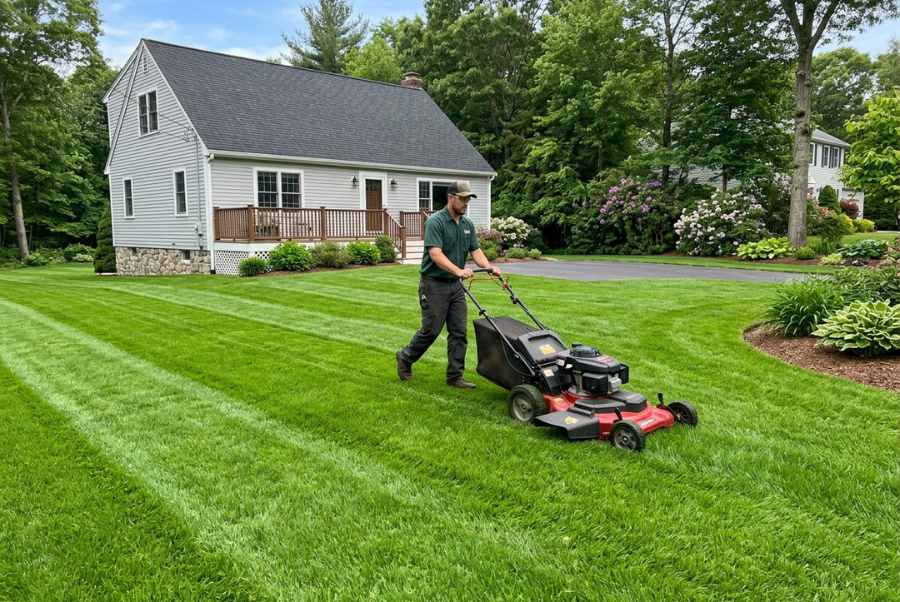
Not every lawn should be maintained in exactly the same way.
Different turfgrass species have different growth habits, environmental tolerances, and maintenance requirements. Those differences can affect how often a lawn needs mowing, how it responds to mowing, and how the mowing routine should change as growing conditions change.
This is especially important for homeowners in Rhode Island, where cool-season grasses such as Kentucky bluegrass, perennial ryegrass, tall fescue, and fine fescues are commonly used. UMass Extension notes that these grasses differ in their tolerance to environmental conditions, wear, mowing, and other stresses.
That does not mean every grass needs a completely different mowing routine.
Instead, the goal is to understand the type of turf growing in your lawn and use a mowing method that fits its growth characteristics and the conditions of the property.
Why Does Grass Type Affect Lawn Mowing Methods?
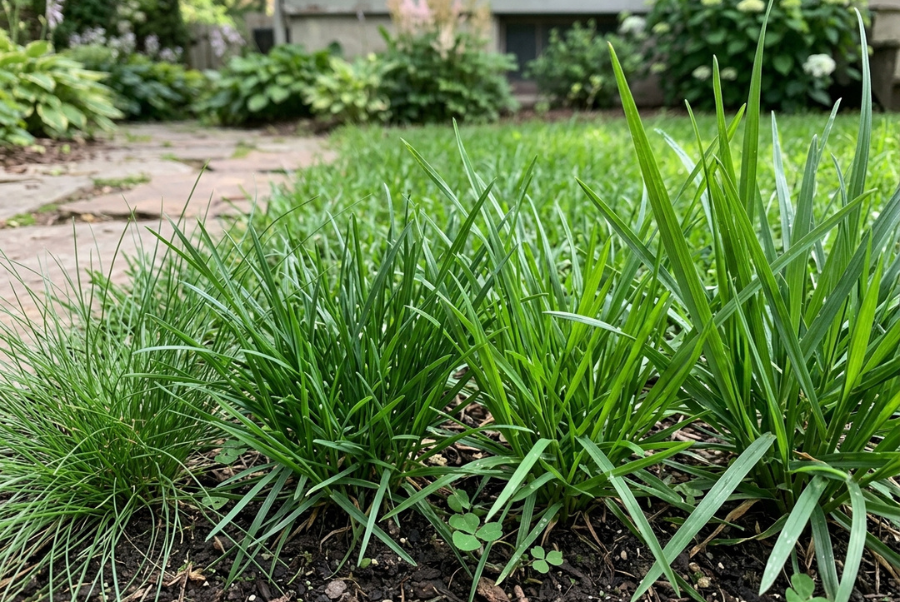
Grass type matters because turfgrasses do not all grow in the same way.
Some grasses spread through rhizomes or stolons, while others grow primarily as bunch-type grasses. Some tolerate heat and drought better than others. Some are better suited to shade, while others perform best in sunny areas.
UMass Extension explains that turfgrass species vary in appearance, cultural requirements, stress tolerance, and maintenance needs. Selecting and managing grass according to site conditions is an important part of successful turf management.
These differences can influence:
- How quickly the lawn grows
- How frequently it needs mowing
- How it responds to environmental stress
- How much traffic it can tolerate
- What type of equipment is practical
- How the mowing routine should change throughout the season
The important distinction is that mowing method is broader than mowing height.
Mowing height is one factor, but the overall method also includes how you schedule mowing, how you respond to growth conditions, how you handle clippings, and how you choose equipment.
For that reason, a good mowing routine starts with understanding the grass rather than applying the exact same routine to every lawn.
What Mowing Method Works Best for Cool-Season Grasses?
Cool-season grasses are particularly relevant to homeowners in Rhode Island and throughout much of the Northeast.
UMass Extension identifies Kentucky bluegrass, perennial ryegrass, tall fescue, and fine fescues among the principal cool-season lawn grasses used in the region. These grasses generally grow most actively during cooler periods and can become less active during hot or dry summer conditions.
For cool-season lawns, the most useful mowing method is generally one that follows the grass’s growth rather than relying on an inflexible calendar.
Cool-Season Grass Mowing Method at a Glance
| Grass Species | Primary Growth Habit | Mowing Frequency Tendency | Key Mowing Consideration |
| Kentucky Bluegrass | Spreading / rhizomatous | Low to Medium | Watch for active spring and fall growth; growth can slow during extended summer heat and drought. |
| Perennial Ryegrass | Bunch-type | High | Monitor growth closely during active periods and maintain a consistent mowing routine. |
| Tall Fescue | Bunch-type | Medium to High | Pay attention to heat and drought conditions and adjust the mowing routine as growth changes. |
| Fine Fescues | Various; some creeping | Low | Adapt mowing to slower growth and site conditions such as shade and moisture. |
Kentucky Bluegrass
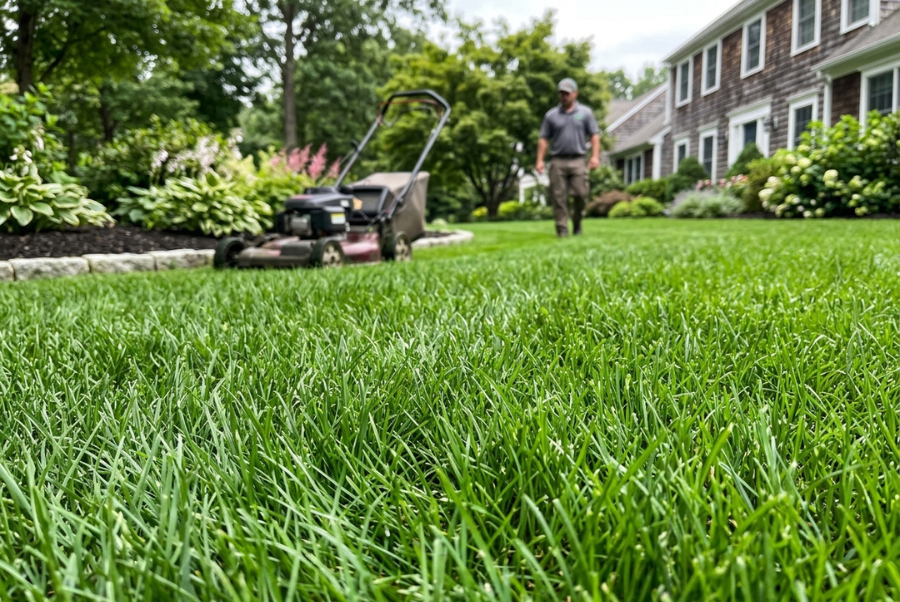
Kentucky bluegrass is a spreading, sod-forming grass that performs well in suitable sunny, well-drained locations.
It can produce a dense lawn and has good cold tolerance, but its growth can slow considerably during hot and dry summer conditions.
A practical mowing approach for Kentucky bluegrass is to:
- Maintain a consistent routine during active growth.
- Pay closer attention during periods of rapid spring and fall growth.
- Adjust mowing when summer conditions reduce growth.
- Avoid forcing frequent mowing when the turf is not actively growing.
- Keep mowing equipment properly maintained.
The key is to follow the condition and growth of the lawn instead of assuming that every week requires exactly the same treatment.
Perennial Ryegrass
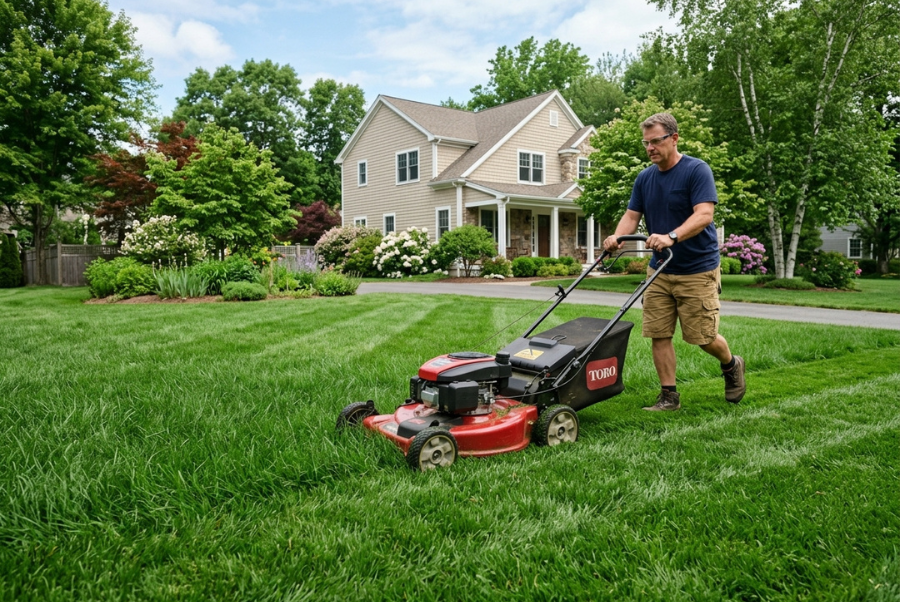
Perennial ryegrass is a cool-season grass known for relatively rapid establishment and good wear tolerance.
UMass Extension notes that it can be used alone or in mixtures and is commonly included in lawns where rapid establishment or wear tolerance is important.
For perennial ryegrass, a practical mowing method includes:
- Monitoring growth closely during active periods.
- Maintaining a consistent mowing routine.
- Avoiding long gaps that allow excessive growth to accumulate.
- Paying attention to heavily used areas.
- Keeping the mower properly maintained.
Because growth can be active under favorable conditions, consistency is particularly useful.
Tall Fescue
Tall fescue is a cool-season turfgrass with characteristics that can make it useful under challenging summer conditions.
UMass Extension describes tall fescue as having good heat and drought tolerance compared with several other cool-season lawn grasses.
A suitable mowing approach for tall fescue is to:
- Monitor actual growth instead of following a rigid schedule.
- Maintain consistency during active growth.
- Pay attention to heat and drought conditions.
- Avoid unnecessarily aggressive mowing when the lawn is stressed.
- Keep equipment capable of producing a clean cut.
Tall fescue’s environmental tolerance does not eliminate the need to adapt mowing to conditions. It simply means the grass may respond differently from less heat- or drought-tolerant turf.
Fine Fescues
Fine fescues include creeping red fescue, Chewings fescue, and hard fescue.
These grasses can be useful in lower-maintenance and shaded lawn situations, depending on the species and site. UMass Extension notes that fine fescues can be included in mixtures designed for different maintenance levels and growing conditions.
A practical approach is to:
- Watch how quickly the turf is growing.
- Adjust mowing frequency to actual growth.
- Consider shade and moisture conditions.
- Avoid unnecessary mowing when growth is slow.
- Maintain properly functioning equipment.
Fine fescues are also commonly part of seed mixtures, which makes it important to consider the characteristics of the entire lawn rather than trying to manage every grass species independently.
What Mowing Method Works Best for Mixed-Grass Lawns?
Many residential lawns contain a mixture of grass species rather than one pure turfgrass.
For example, UMass Extension provides lawn seed mixtures that combine Kentucky bluegrass, perennial ryegrass, and fine fescues for different lawn conditions and maintenance levels.
This means homeowners do not necessarily need a separate mowing routine for every grass in the lawn.
Instead, consider the lawn as a whole.
A practical approach is to:
- Identify the major grass types present.
- Understand the general characteristics of the mixture.
- Observe how quickly the lawn is growing.
- Adjust mowing frequency to growth.
- Pay attention to seasonal stress.
- Maintain equipment properly.
- Use a consistent routine while remaining flexible when conditions change.
The goal is to find a mowing approach that works for the actual turf mixture and property conditions.
How Should Mowing Change When Grass Is Growing Quickly?
Mowing frequency should respond to growth.
UMass Extension identifies turfgrass species, temperature, day length, moisture availability, and soil fertility among the factors that influence turf growth rate and therefore mowing frequency.
During periods of rapid growth, the best mowing method is generally to stay ahead of excessive growth rather than waiting until the lawn becomes significantly overgrown.
That means:
- Monitor the lawn regularly.
- Adjust the mowing schedule when growth accelerates.
- Avoid allowing excessive growth to accumulate.
- Maintain consistency during active growth.
- Avoid removing an unnecessarily large amount of grass at once.
This is particularly relevant during periods when cool-season lawns are growing actively.
The objective is not simply to mow more often.
It is to keep the mowing routine aligned with the rate at which the turf is actually growing.
How Should Mowing Change During Heat or Drought?
Cool-season grasses can behave differently when summer conditions become hot or dry.
UMass Extension notes that many cool-season grasses can become semi-dormant during hot or dry periods, while individual species differ in their tolerance to those conditions.
When the lawn is under environmental stress, homeowners should avoid treating it as though it were growing under ideal conditions.
A better approach is to:
- Observe whether the grass is actively growing.
- Reduce mowing frequency when growth slows.
- Avoid unnecessary mowing during periods of stress.
- Pay attention to the condition of the turf before mowing.
- Resume a more active mowing routine as growing conditions improve.
The exact response will depend on the grass species and site conditions.
This is one reason grass-aware mowing is more useful than a rigid calendar-based approach.
What About Warm-Season Grasses?
Warm-season grasses require a different seasonal approach because they are adapted to warmer growing conditions.
Common examples include:
- Bermudagrass
- Zoysiagrass
- Centipedegrass
- St. Augustinegrass
These grasses are more commonly associated with warmer climates than Rhode Island.
The important lesson for homeowners is that a mowing routine developed for a warm-season lawn should not automatically be transferred to a cool-season lawn.
Warm-season grasses have different periods of active growth and different management requirements. Their mowing routine should therefore be based on the specific grass and local growing conditions.
For Rhode Island homeowners, the more relevant consideration is usually the management of cool-season turf.
Does Mowing Equipment Affect the Method?
Equipment can also influence how a lawn is maintained.
UMass Extension explains that rotary mowers are the most common type used on home lawns, while reel mowers are more commonly associated with fine turf and higher-maintenance areas. It also emphasizes the importance of keeping mower blades sharp.
For a typical residential lawn, the important considerations are:
- Choose equipment appropriate for the property.
- Make sure the mower can handle the lawn’s growth.
- Keep the cutting equipment properly maintained.
- Keep blades sharp.
- Avoid using equipment that is unnecessarily heavy for the site.
A dull blade can tear rather than cleanly cut grass, which can injure turf and contribute to a brownish appearance.
The mower should support the mowing method rather than dictate it.
What Should You Do With Grass Clippings?
Grass clippings can often remain on the lawn when mowing is performed properly.
The Grass Recycling Rule: Leave finely cut clippings on the lawn whenever practical. They decompose quickly and return nutrients to the turf. Recycled grass clippings can provide a portion of the lawn’s nutrient needs while reducing the need for additional fertilizer.
UMass Extension recommends recycling clippings into the turf canopy whenever practical because returned clippings can retain nutrients within the turf system. It also notes that mulching mowers can help distribute finely cut clippings into the lawn.
The practical approach is to:
- Avoid excessive clipping accumulation.
- Keep clippings distributed rather than concentrated in piles.
- Mow often enough to avoid producing excessive clipping volume.
- Clean clippings from paved surfaces after mowing.
Clipping management is therefore another part of the overall mowing method, regardless of the particular grass species.
How Do You Choose the Right Mowing Method for Your Lawn?
If you are unsure how to approach mowing, start with the turf and the conditions of the property.
1. Identify the Grass
Determine whether your lawn contains Kentucky bluegrass, perennial ryegrass, tall fescue, fine fescue, a mixture, or another turfgrass.
2. Consider the Growing Conditions
Sunlight, shade, moisture, temperature, and seasonal conditions can all influence turf growth.
3. Watch the Growth Rate
A lawn growing rapidly needs a different mowing schedule from one that has slowed because of heat, drought, or other environmental conditions.
4. Consider How the Lawn Is Used
Foot traffic and the intended use of the lawn can affect how much maintenance attention it needs.
5. Maintain the Equipment
Use equipment that is appropriate for the property and keep the cutting equipment in good condition.
6. Adjust With the Season
The mowing approach that works during active spring or fall growth may not be appropriate when a cool-season lawn slows during summer stress.
This does not make lawn mowing unnecessarily complicated.
It simply means that the most effective method is the one that responds to the grass and the conditions instead of treating every lawn identically.
What Is the Best Overall Mowing Method for Rhode Island Lawns?
For many Rhode Island homeowners, understanding the characteristics of cool-season turf is the best starting point.
Kentucky bluegrass, perennial ryegrass, tall fescue, and fine fescues can all be used in Northeast lawns, but they differ in growth characteristics and environmental tolerance.
A practical grass-aware mowing method is to:
- Identify the turfgrass or mixture.
- Monitor its growth.
- Adjust mowing frequency to growth.
- Pay attention to seasonal stress.
- Use equipment appropriate for the property.
- Keep mower blades maintained.
- Manage clippings responsibly.
- Adjust the routine when growing conditions change.
The key takeaway is simple:
The best mowing method is not necessarily the same for every lawn.
The grass, property, and growing conditions should determine how the mowing routine is managed.
Lawn Mowing in Coventry, RI
Homeowners in Coventry and the surrounding Rhode Island area commonly maintain cool-season residential lawns, making grass-aware mowing especially useful throughout the growing season.
Doug Greenwood Landscaping Co. provides lawn care and maintenance services that include lawn mowing and trimming, along with other lawn-care services such as aeration, overseeding, fertilization, weed control, and irrigation system maintenance.
The company’s approach is based on providing lawn care according to the needs and preferences of individual properties.
Doug Greenwood Landscaping Co.
33 Carr St
Coventry, RI 02816
Phone: (401) 441-9580
Frequently Asked Questions
Does grass type really affect lawn mowing?
Yes. Different turfgrass species have different growth habits, environmental tolerances, and maintenance requirements. Those differences can affect how mowing should be scheduled and managed.
What is the best mowing method for Kentucky bluegrass?
Maintain a consistent mowing routine during active growth while adjusting the schedule when hot or dry conditions slow the grass’s growth.
Is tall fescue mowed differently from Kentucky bluegrass?
The overall approach can be similar, but tall fescue has different environmental characteristics, including relatively strong heat and drought tolerance. The mowing routine should still respond to actual growth and lawn conditions.
How should fine fescue be mowed?
Fine fescue should be maintained according to its growth rate and site conditions. Shade, moisture, and seasonal growth can affect how frequently it needs mowing.
Should a mixed-grass lawn be mowed differently?
A mixed lawn should be managed according to the characteristics of the overall turf mixture and the conditions of the property. A separate routine for every grass species is generally unnecessary.
Do warm-season grasses require a different mowing method?
Yes. Warm-season grasses have different active growth periods and management requirements from cool-season grasses. Their mowing routine should be based on the specific species and local climate.
Should grass clippings be left on the lawn?
Grass clippings can generally be left on the lawn when they are distributed appropriately and are not accumulating in excessive piles. Properly managed clippings can return nutrients to the turf.
Is there one mowing method that works for every grass type?
No. The best approach is to identify the turfgrass, understand its growth characteristics, and adjust mowing according to the lawn’s condition and growing environment.
Conclusion
Different grass types can require different approaches to lawn mowing.
Kentucky bluegrass, perennial ryegrass, tall fescue, and fine fescues are all common cool-season turfgrasses in the Northeast, but they differ in growth characteristics and environmental tolerance.
That means effective mowing is less about finding one universal routine and more about understanding the lawn you actually have.
Identify the grass, watch how it grows, and adjust the mowing routine to the conditions.
For homeowners who do not have the time, equipment, or consistency needed to maintain their lawn, professional lawn care can make routine maintenance easier.
Doug Greenwood Landscaping Co. provides lawn care and maintenance services for properties in Coventry, Rhode Island.
Need help maintaining your lawn?
Call Doug Greenwood Landscaping Co. at (401) 441-9580 or schedule a consultation to discuss your lawn-care needs.
Related Lawn Mowing Resources
- What Is Lawn Mowing and Why Is It Important?
- What Lawn Mowing Mistakes Can Damage Your Lawn?
- What Are the Best Lawn Mowing Techniques for a Healthier Lawn?
- What Is the Optimal Mowing Height for Different Grass Types?