

What is lawn mowing? It is the routine process of cutting grass to manage its growth and maintain a consistent, manageable appearance.
Although mowing may seem like a simple chore, it is an important part of basic lawn care. Regular mowing helps homeowners keep grass under control, maintain the appearance of their property, and support a consistent lawn-maintenance routine.
Good mowing, however, is not simply about making the grass shorter. The way a lawn is mowed can affect how the turf responds to growing conditions and ongoing maintenance.
What Is Lawn Mowing?
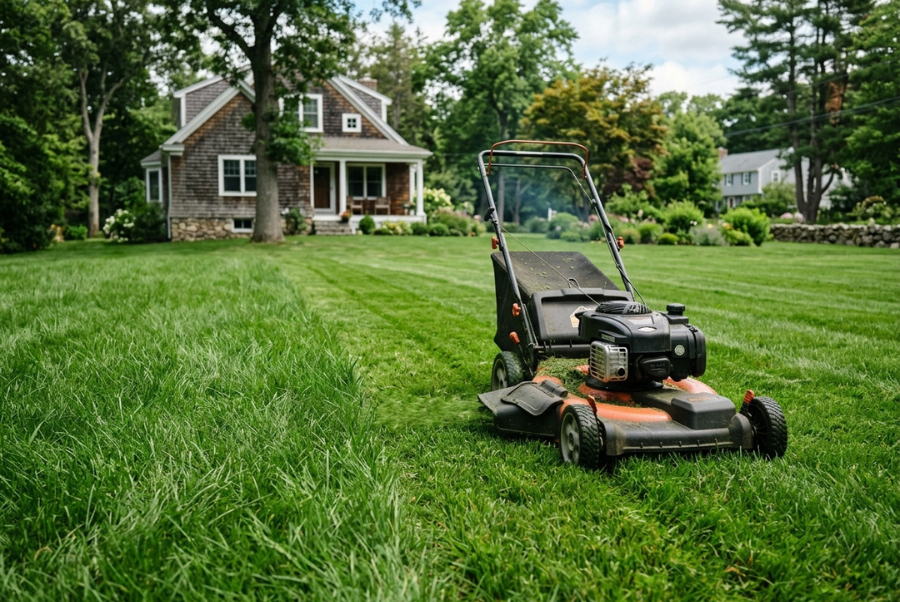
Lawn mowing is the routine practice of cutting grass to manage its growth and maintain a healthy, well-kept appearance.
As grass grows, it needs to be managed so the lawn does not become excessively tall or difficult to maintain. Mowing provides a consistent way to manage that growth while keeping the property looking maintained.
For most homeowners, mowing is one of the most visible parts of lawn care. It is also one of the tasks that needs to be repeated throughout periods of active growth.
Lawn Mowing vs. Lawn Maintenance
Lawn mowing focuses primarily on cutting and managing grass growth.
Lawn maintenance is broader and can include practices such as aeration, overseeding, fertilization, weed control, irrigation maintenance, and other ongoing care.
Doug Greenwood Landscaping’s Lawn Care & Maintenance services reflect this broader approach, combining mowing and trimming with aeration and overseeding, fertilization and weed control, irrigation system maintenance, and personalized lawn-care consultation.
Why Is Lawn Mowing Important?
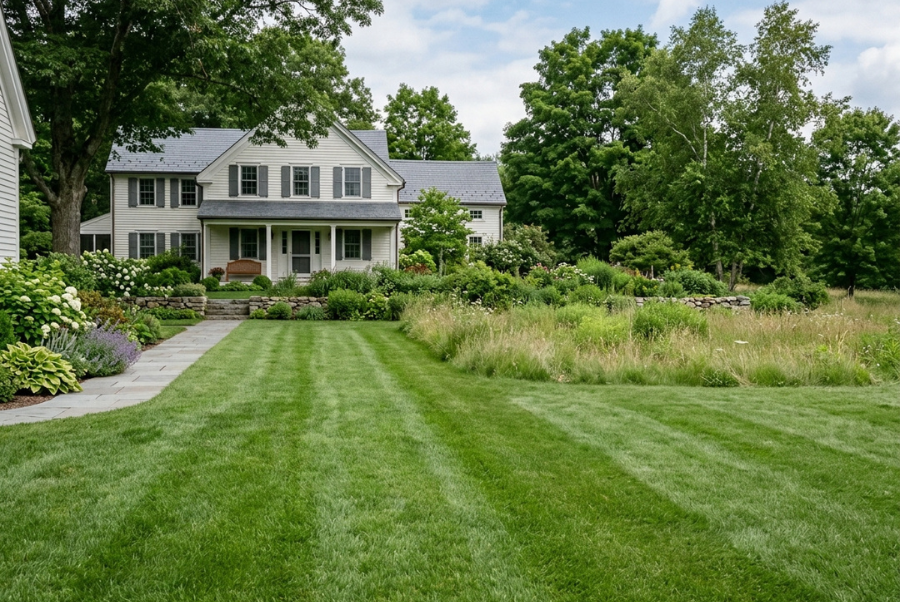
Regular lawn mowing helps manage grass growth, maintain a consistent appearance, and keep the lawn easier to maintain throughout the growing season.
Regular mowing serves several basic purposes.
It Helps Manage Grass Growth
Grass continues to grow as conditions allow. Without regular maintenance, a lawn can become overgrown and increasingly difficult to manage.
Mowing provides a way to control that growth and keep the lawn within a manageable range.
How frequently mowing is needed can vary depending on growing conditions. The goal is not to follow an arbitrary schedule but to maintain the lawn appropriately as it grows.
It Maintains a Consistent Appearance
A regularly mowed lawn generally presents a more orderly appearance than grass that has been allowed to grow unchecked.
Consistent mowing can help create a more uniform surface and contribute to the overall presentation of the property.
For homeowners who care about curb appeal, lawn mowing is therefore an important part of keeping the landscape looking maintained.
It Supports Good Lawn-Care Practices
Mowing is one of the regular practices that can influence turf condition.
University of Rhode Island Cooperative Extension’s Healthy Lawn Care guidance identifies proper mowing alongside fertilizing, watering, and addressing soil and thatch issues as part of maintaining an established lawn.
The important point is that mowing works best when it is approached as part of an overall care routine.
How Does Proper Lawn Mowing Support a Healthy Lawn?
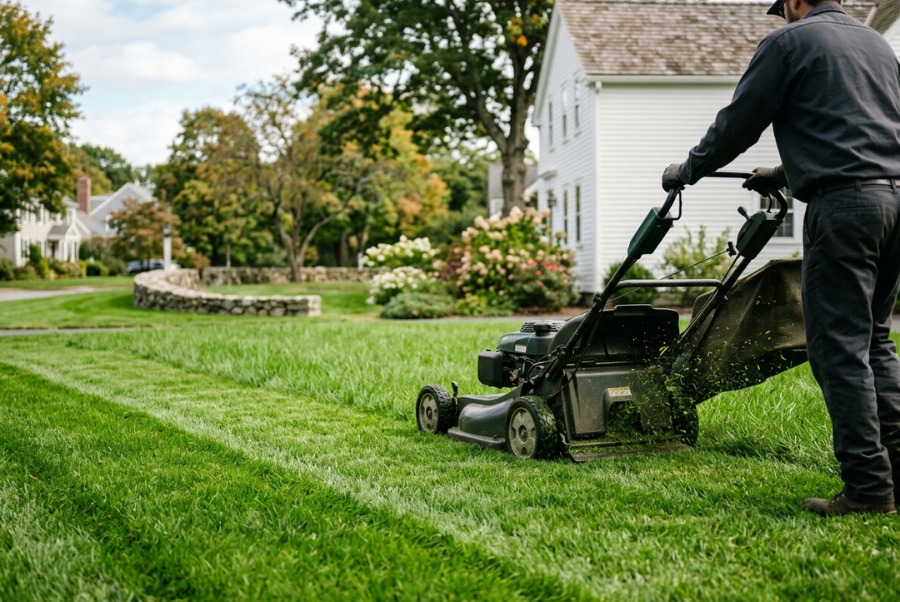
Proper mowing helps maintain the lawn without placing unnecessary stress on the turf, and the right approach can vary according to grass type and growing conditions.
Good mowing starts with understanding that a lawn should not simply be cut as short as possible.
Grass needs sufficient leaf area to continue growing effectively, and the appropriate approach can vary according to grass type, growing conditions, and how the lawn is used.
The 1/3 Rule
Avoid removing more than one-third of the grass’s existing shoot growth in a single mowing. Removing too much at once can stress the turf, so excessively tall grass may need to be brought down gradually over several mowings. UMass Extension — Lawn Mowing
For homeowners, the basic principle is straightforward: mow consistently, avoid unnecessarily aggressive cutting, and pay attention to the condition of the lawn.
Other factors can also matter, including:
- Grass type
- Growth rate
- Weather conditions
- Lawn condition
- Mowing height
- Mower blade condition
- Overall lawn-care practices
The detailed techniques behind these decisions deserve their own guides. Homeowners can learn more about lawn mowing techniques, optimal mowing height, and lawn mowing methods by grass type.
What Happens When a Lawn Is Mowed Incorrectly?
Improper mowing can stress turf and contribute to a weaker or less attractive lawn, particularly when grass is cut too aggressively or inappropriate practices are repeated.
Simply mowing a lawn does not necessarily mean it is being maintained properly.
Mowing too aggressively, using inappropriate mowing practices, or repeatedly stressing the grass can contribute to a weaker or less attractive lawn.
One common issue is cutting the grass too short. UMass Extension notes that lower cutting heights can reduce leaf area, shorten root systems, and make turf less tolerant of environmental stress.
Other mowing problems can affect the lawn’s appearance and consistency.
For more detail, see What Lawn Mowing Mistakes Can Damage Your Lawn? once that supporting article is published.
How Often Should a Lawn Be Mowed?
A lawn should generally be mowed according to its growth rate and current conditions rather than according to one fixed schedule that applies to every property.
There is no single mowing schedule that works for every lawn.
Mowing frequency depends largely on how quickly the grass is growing and the conditions affecting the property. UMass Extension identifies factors such as turfgrass species, temperature, moisture, day length, and soil fertility as influences on growth rate and mowing frequency.
A useful general principle is to avoid allowing the lawn to become excessively tall and then removing a large amount of growth at once.
Instead, homeowners should pay attention to the lawn’s growth and mow when it needs attention.
This is particularly important during periods of rapid growth, when a lawn may need more frequent mowing.
Does Lawn Mowing Depend on Grass Type?
Yes. Different grass types have different growth and management characteristics, so mowing practices should be appropriate for the turf being maintained.
For homeowners in Rhode Island and across New England, cool-season turfgrasses are an important part of the local lawn-care context. Grass type can influence mowing practices, growth rate, mowing height, and how frequently the lawn needs attention.
Different grass types can have different growth and management characteristics. That means mowing practices should be appropriate for the type of turf being maintained rather than based on one universal rule.
Grass type can influence considerations such as:
- Mowing height
- Growth rate
- Frequency of mowing
- Tolerance for different mowing practices
- Response to environmental stress
UMass Extension’s Turfgrass Selection guidance provides regional guidance for selecting and managing turfgrass species under New England conditions.
For a deeper explanation, see Which Lawn Mowing Methods Work Best for Different Grass Types? once that supporting article is published.
You can also learn more about optimal mowing height for different grass types once the dedicated supporting article is published.
Can Mowing Patterns Improve a Lawn’s Appearance?
Mowing patterns can change the visual appearance of a lawn, while varying mowing direction can also help avoid repeatedly mowing the turf in exactly the same direction.
Mowing patterns can affect the visual appearance of a lawn.
Changing mowing direction can create different visual effects and can also help avoid repeatedly traveling over the lawn in exactly the same direction.
UMass Extension recommends varying mowing direction to promote upright shoot growth and help minimize the formation of horizontal growth patterns in turf.
For homeowners interested specifically in the visual side of mowing, Lawn Mowing Patterns provides a more focused look at the subject.
What About Mowing Large Properties?
Larger properties can make routine lawn mowing more time-consuming, particularly when the property has extensive lawn areas, obstacles, slopes, or equipment requirements.
The amount of lawn, property layout, obstacles, slopes, and equipment required can all affect how practical it is for a homeowner to handle mowing independently.
For a more detailed discussion, see What Should Homeowners Know About Lawn Mowing Large Properties?
What Other Lawn Care Does a Lawn Need Besides Mowing?
Mowing manages grass growth and appearance, but other lawn conditions may require additional care such as aeration, overseeding, fertilization, weed control, or irrigation maintenance.
Mowing addresses grass growth and appearance, but other lawn conditions may require additional care.
Depending on the property, broader lawn maintenance may include:
- Aeration
- Overseeding
- Fertilization
- Weed control
- Irrigation maintenance
- Trimming
- Seasonal maintenance
- Lawn-care consultation
URI Cooperative Extension’s guidance similarly treats mowing as part of a broader lawn-care approach that can include fertilizing, watering, and addressing soil compaction and thatch.
That broader perspective is important because regular mowing does not automatically resolve issues involving weeds, irrigation, soil conditions, or thinning turf.
When Does Professional Lawn Mowing Make Sense?
Professional lawn mowing may make sense when regular maintenance becomes difficult to manage because of time, property size, equipment, or the homeowner’s preference for ongoing professional care.
For some homeowners, mowing their own lawn is a practical part of maintaining their property.
For others, regular mowing can become difficult to keep up with.
Professional lawn mowing may be worth considering when:
- There is not enough time for regular maintenance.
- The property has a large amount of lawn.
- Maintaining a consistent mowing routine has become difficult.
- The homeowner does not want to handle the equipment and physical work.
- The homeowner wants mowing to be part of a broader lawn-maintenance service.
The decision depends on the property, schedule, maintenance expectations, and personal preferences.
Homeowners comparing the two approaches can read DIY vs. Professional Lawn Mowing.
If cost is an important consideration, see How Much Does Professional Lawn Mowing Cost in Coventry, RI?.
For homeowners who are still unsure whether professional help is necessary, Do You Really Need Professional Lawn Mowing Services? addresses that question directly.
You can also explore Is Professional Lawn Mowing Worth It? and the benefits of professional lawn mowing services.
What Should Homeowners Look For in a Lawn Mowing Service?
Homeowners comparing lawn mowing providers should consider reliability, consistency, communication, quality of work, and whether the provider can address the property’s broader maintenance needs.
If you decide to hire a lawn mowing provider, the service itself matters.
Homeowners may want to consider:
- Reliability
- Consistency
- Communication
- Quality of work
- Attention to the property’s needs
- Whether the provider can address other lawn-maintenance needs when appropriate
These considerations become especially important when mowing is expected to continue throughout the growing season.
For homeowners in Coventry, Rhode Island, Doug Greenwood Landscaping’s Lawn Care & Maintenance service provides information about its lawn-care and maintenance services, including lawn mowing and trimming.
Frequently Asked Questions About Lawn Mowing
What is lawn mowing?
Lawn mowing is the routine process of cutting grass to manage its growth and maintain a manageable, consistent lawn appearance.
Why is lawn mowing important?
Lawn mowing helps manage grass growth, maintain a consistent appearance, and support a regular lawn-care routine.
Is lawn mowing part of lawn maintenance?
Yes. Mowing is one of the practices used to maintain a lawn, alongside other potential needs such as aeration, overseeding, fertilization, weed control, and irrigation maintenance.
How often should a lawn be mowed?
Mowing frequency depends on how quickly the grass is growing and the conditions affecting the lawn, so there is no single schedule for every property.
Can improper mowing damage a lawn?
Yes. Cutting grass too aggressively or using inappropriate mowing practices can stress turf and contribute to an unhealthy or unattractive lawn.
Does grass type affect mowing?
Yes. Different grass types can have different growth and management characteristics, so mowing practices may need to be adjusted accordingly.
Can mowing patterns affect a lawn?
Yes. Changing mowing direction can influence the lawn’s appearance and can help avoid repeatedly mowing in exactly the same direction.
Is mowing enough to maintain a healthy lawn?
No. Mowing addresses grass growth, but other lawn-care needs may include watering, fertilization, weed control, aeration, overseeding, and irrigation maintenance.
Key Takeaways
Lawn mowing is a basic but important part of maintaining a manageable, attractive lawn, but it works best when considered alongside the property’s broader lawn-care needs.
The way a lawn is mowed can influence its appearance and how well the turf handles ongoing maintenance. Grass type, growth conditions, mowing practices, and the property’s broader lawn-care needs all matter.
For homeowners maintaining their own lawns, understanding these basics provides a useful foundation for making better mowing decisions.
And when regular mowing becomes difficult to manage because of time, property size, or other circumstances, professional lawn care can provide another option.
Need Help With Your Lawn Care?
If keeping up with regular mowing and lawn maintenance has become difficult, Doug Greenwood Landscaping Co. can help you discuss the needs of your property.
For a broader look at available lawn-care services, visit the Lawn Care & Maintenance service page.
Doug Greenwood Landscaping Co.
33 Carr St
Coventry, RI 02816
(401) 336-6032
If you’d like to discuss your lawn’s needs, Contact Us.