
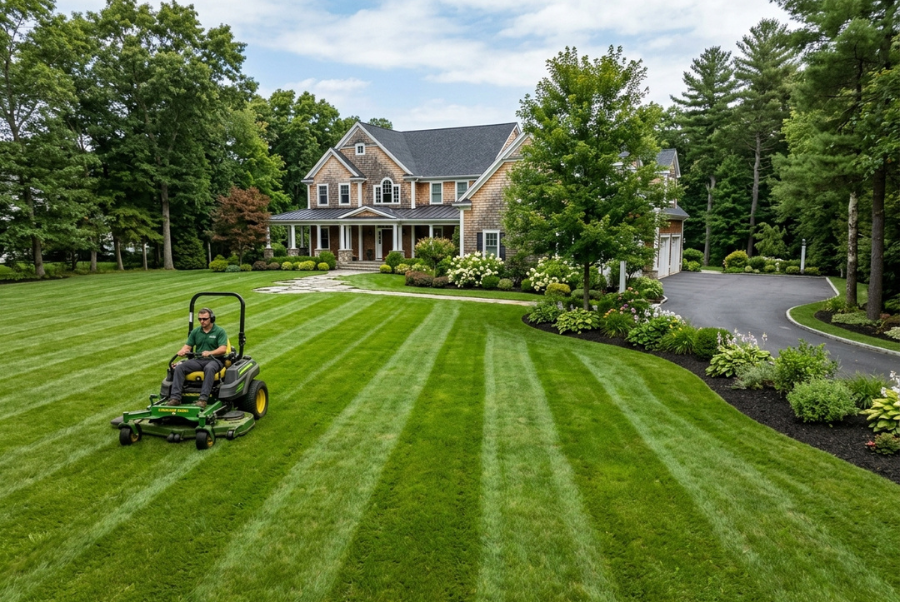
Mowing a large property requires more planning than mowing a typical residential lawn.
The challenge is not simply having more grass to cut. Large properties may have multiple lawn areas, slopes, trees, garden beds, fences, walkways, buildings, and other landscape features that affect how the mower can move through the property.
The amount of lawn also increases the time required for each mowing session. Equipment, terrain, grass growth, and the property’s overall layout can all influence how efficiently the work can be completed.
For homeowners maintaining large residential properties, the most effective approach is to consider the entire property before deciding how to organize the mowing routine.
What Makes Lawn Mowing a Large Property Different?
Several factors can make mowing a large property more complicated than maintaining a smaller lawn.
More Lawn Takes More Time
The most obvious difference is the amount of turf that needs to be maintained.
A larger lawn requires more mowing passes, more turning, and more time behind the mower. If the property contains several separate lawn areas, additional time may also be needed to move equipment between sections.
This makes consistency important. A mowing routine that works well for a small lawn may become inefficient when applied to a much larger property.
The Property May Have Multiple Lawn Areas
Large residential properties are not always one continuous area of grass.
A property may have:
- A front lawn
- Side-yard areas
- A large backyard
- Separate lawn sections
- Narrow areas around landscaping
- Open spaces surrounding trees or garden beds
Treating each area as part of a planned route can make the mowing process easier to organize.
Landscaping Creates More Obstacles
Large properties may also contain more landscape features that require careful maneuvering.
Common obstacles include:
- Trees
- Garden beds
- Fences
- Walkways
- Patios
- Retaining walls
- Buildings
- Landscape structures
These features can increase the number of turns required and may leave areas that need trimming after mowing.
The goal is to maintain the turf while avoiding damage to surrounding plants, structures, and landscape features.
Slopes and Uneven Ground Require More Attention
Terrain can significantly affect how a large property should be mowed.
A property may include relatively flat lawn areas as well as slopes, uneven ground, or areas with limited access. These conditions can affect maneuverability and may require a slower and more deliberate mowing approach.
The size of the property therefore should not be considered separately from its terrain.
Equipment Needs Can Change With Property Size
The appropriate mowing equipment depends on more than the amount of grass.
Homeowners should also consider:
- Property layout
- Terrain
- Obstacles
- Lawn accessibility
- Maneuverability
- Frequency of use
- Equipment maintenance
A larger mower is not automatically the best choice for every large property. Equipment needs to be appropriate for the actual conditions of the lawn.
How Should You Plan Lawn Mowing for a Large Property?
A planned mowing routine can reduce unnecessary movement and make a large property easier to manage.
Divide the Property Into Manageable Sections
Start by identifying the major lawn areas.
For example:
- Front lawn
- Side lawn
- Backyard
- Open lawn areas
- Smaller sections around landscape features
Breaking the property into sections makes it easier to track progress and avoid accidentally skipping areas.
It also provides a repeatable structure for future mowing sessions.
Plan the Mowing Route
Once the lawn is divided into sections, determine how the mower will move through them.
Consider:
- Where the mower enters the lawn
- Which sections are easiest to access
- Where obstacles are located
- How the mower will move between sections
- Where unnecessary backtracking can be avoided
On a large property, an inefficient route can add significant time because the same unnecessary movements are repeated across a much larger area.
Account for Obstacles Before You Start
Identify trees, planting beds, fences, walkways, and other obstacles before mowing.
Knowing where these features are located allows you to plan the route around them instead of repeatedly changing direction while mowing.
This can also help protect landscaping from accidental contact with mowing equipment.
Monitor Grass Growth
A large property should not automatically be mowed according to a fixed calendar.
Mowing frequency depends on how quickly the grass is growing and the conditions affecting the property. Penn State Extension recommends basing mowing frequency on grass growth, noting that lawns may need more frequent mowing during peak growth and less mowing during drought when active growth slows.
During periods of faster growth, the lawn may require more frequent mowing. When growth slows, the interval may increase.
The better approach is to monitor the lawn rather than assuming that every large property needs exactly the same mowing schedule.
Avoid Allowing Grass to Become Excessively Tall
Waiting too long between mowing sessions can create a larger job and may result in removing too much leaf tissue at once.
A commonly used mowing principle is to avoid removing more than one-third of the grass blade during a single mowing. University of Minnesota Extension recommends removing no more than one-third of the leaf tissue during mowing, and Penn State Extension also identifies the one-third rule as a useful mowing guideline.
Following this approach can help keep mowing more consistent and reduce unnecessary stress on the turf.
For broader mowing guidance, see What Are the Best Lawn Mowing Techniques for a Healthier Lawn?
What Challenges Can Make Large-Property Mowing More Difficult?
The difficulty of mowing a large property depends on more than its total lawn area.
Time Commitment
A large lawn naturally requires more mowing time.
The total maintenance commitment may include:
- Mowing
- Trimming
- Equipment preparation
- Moving between lawn sections
- Equipment cleanup
- Equipment maintenance
For homeowners with extensive properties, the time required for each mowing session can become a significant part of their regular property-maintenance routine.
Complex Property Layout
A property with several separate lawn sections may take longer to mow than a similarly sized open lawn.
Every transition between areas adds movement, and narrow spaces or irregular lawn shapes can require additional maneuvering.
Slopes and Uneven Areas
Uneven terrain can make mowing slower and more demanding.
Instead of treating the entire property the same way, homeowners should recognize that different sections may require different mowing approaches based on terrain and accessibility.
Landscaping Features
A heavily landscaped property may require more maneuvering around trees, beds, walkways, and structures.
This can make mowing less about covering distance and more about navigating the property efficiently.
Equipment Requirements
Large properties may require equipment that is appropriate for extended mowing sessions and the property’s specific conditions.
Equipment that is difficult to maneuver, poorly maintained, or unsuitable for the terrain can make the work less efficient.
How Can Homeowners Make Large-Property Mowing More Efficient?
Efficiency does not mean simply mowing faster.
It means reducing unnecessary work while maintaining consistent mowing practices.
1. Use a Repeatable Route
Create a mowing sequence that works with the property’s layout.
Using the same general route each time makes it easier to remember which areas have already been completed.
2. Separate Open Areas From Difficult Sections
Large open lawn areas can often be handled differently from narrow or heavily landscaped sections.
Recognizing these differences can help organize the mowing process more effectively.
3. Keep Equipment Properly Maintained
Mower blades and other equipment should be maintained appropriately.
A properly maintained mower can help produce a more consistent cut and avoid unnecessary interruptions during a large mowing job. University of Minnesota Extension recommends keeping mower blades sharp and equipment properly maintained.
4. Plan Around Obstacles
Rather than discovering obstacles as you mow, identify them beforehand.
This makes it easier to determine where to turn, which areas require additional maneuvering, and where trimming may be needed afterward.
5. Adjust the Routine to Grass Growth
Do not let property size dictate mowing frequency by itself.
The lawn’s growth rate remains an important factor. A large property with slow-growing grass may not require the same mowing frequency as another large property experiencing rapid growth. Penn State Extension recommends adjusting mowing frequency according to grass growth and seasonal conditions.
6. Avoid Mowing More Than Necessary
A large lawn can make unnecessary passes costly in terms of time and effort.
A planned route and consistent mowing pattern can help minimize repeated passes over areas that have already been completed.
For related guidance on mowing patterns, see Which Lawn Mowing Patterns Improve Curb Appeal?
How Does Property Layout Affect Lawn Mowing?

Property layout can have a surprisingly large effect on mowing efficiency.
Two properties with similar amounts of lawn can require very different amounts of work.
An open lawn with few obstacles may allow relatively continuous mowing.
A property with the same amount of turf but multiple:
- Trees
- Beds
- Walkways
- Structures
- Fences
- Narrow sections
may require substantially more turning and maneuvering.
Open Lawn Areas
Open areas generally allow longer mowing passes and fewer interruptions.
These areas are usually easier to organize into a consistent route.
Narrow Lawn Sections
Narrow spaces may require additional turning and maneuvering.
The mower needs to fit comfortably within the available space without damaging nearby landscaping.
Irregular Lawn Shapes
Curved or irregular lawn edges can also increase the amount of maneuvering required.
Planning the route around these shapes can help reduce unnecessary backtracking.
Multiple Separated Lawn Areas
When lawn sections are separated by driveways, gardens, buildings, or other features, the time required to move between them becomes part of the overall mowing task.
This is one reason why property layout matters almost as much as lawn size.
How Does Terrain Affect Mowing a Large Property?
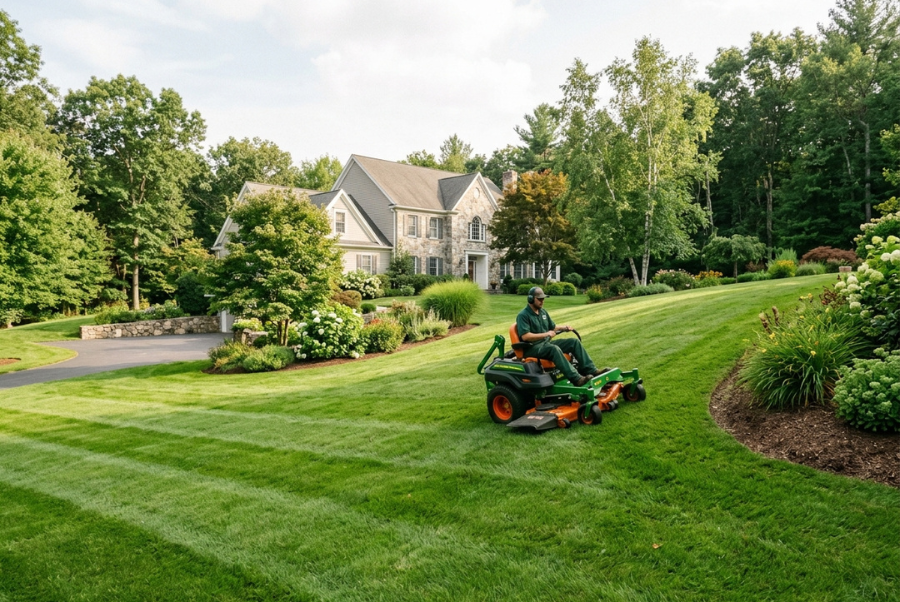
Terrain should be considered before choosing a mowing routine or equipment.
Flat Areas
Flat, open lawn areas are generally easier to organize and mow consistently.
Sloped Areas
Slopes require greater attention to maneuverability and mowing direction.
The appropriate approach depends on the steepness, surface condition, equipment, and surrounding landscape.
Uneven Areas
Uneven ground can make mowing more difficult because the mower may not move through the area as smoothly as it does across a level lawn.
Homeowners should also consider whether certain areas are better suited to mowing at a different pace or with different equipment.
What Equipment Considerations Matter for Large Properties?

There is no single mower that is ideal for every large property.
The right equipment depends on the property’s characteristics.
Property Size
Larger lawn areas may make productivity more important because the mower will be used for longer periods.
Maneuverability
A mower needs to move effectively around trees, beds, structures, and other obstacles.
Terrain
Slopes and uneven ground may affect what equipment is appropriate.
Access
Gate widths, narrow passages, and separated lawn sections can influence equipment selection.
Maintenance
Equipment used frequently should be maintained properly so it can perform consistently when needed.
The best equipment is therefore the equipment that matches the property rather than simply the equipment with the greatest size or capacity.
What Other Maintenance May Be Needed on a Large Property?
Mowing is an important part of lawn maintenance, but it is not the only task a large property may require.
Depending on lawn condition and property needs, homeowners may also need to consider:
- Aeration
- Overseeding
- Fertilization
- Weed control
- Irrigation maintenance
- Trimming
- Seasonal lawn maintenance
Doug Greenwood Landscaping’s verified Lawn Care & Maintenance service includes lawn mowing and trimming as well as aeration, overseeding, fertilization, weed control, irrigation maintenance, and lawn-care consultation.
The important distinction is that these are additional maintenance considerations, not part of the primary question of how to mow a large property.
What Should Homeowners Consider Before Mowing a Large Property?
Before establishing a mowing routine, evaluate the property as a whole.
| Consideration | Question to Ask |
| Property size | How much lawn actually needs to be mowed? |
| Layout | Are the lawn areas connected or separated? |
| Terrain | Are there slopes or uneven sections? |
| Obstacles | How many trees, beds, fences, and structures require maneuvering? |
| Access | Can the mower easily reach every lawn section? |
| Grass growth | How quickly does the lawn typically grow? |
| Equipment | Is the available equipment appropriate for the property? |
| Time | Can the mowing routine be completed consistently? |
| Other maintenance | Does the property require trimming or additional lawn-care work? |
These factors provide a more useful picture of the mowing challenge than property size alone.
Lawn Mowing for Large Properties in Coventry, RI
Large residential properties in Coventry, Rhode Island, can require more planning when lawn areas are extensive or the property contains multiple landscape features.
Doug Greenwood Landscaping Co. provides Lawn Care & Maintenance services that include lawn mowing and trimming, along with additional lawn-care services such as aeration, overseeding, fertilization, weed control, irrigation maintenance, and personalized lawn-care consultation.
For homeowners with larger properties, these services can be part of a broader approach to keeping the lawn consistently maintained.
Doug Greenwood Landscaping Co.
33 Carr St
Coventry, RI 02816
Phone: (401) 336-6032
Website: https://douggreenwoodlandscaping.com/
Service page: Lawn Care & Maintenance
Contact Us to discuss your lawn-care needs.
Frequently Asked Questions About Lawn Mowing Large Properties
What makes mowing a large property different from mowing a small lawn?
A large property generally requires more mowing time and may involve more lawn sections, obstacles, terrain changes, equipment requirements, and travel between areas.
How often should a large property be mowed?
There is no single mowing schedule based on property size. Mowing frequency should respond primarily to grass growth and the conditions affecting the lawn.
Does a large lawn need a different mowing strategy?
It can. Dividing the property into sections, planning the mowing route, accounting for obstacles, and selecting suitable equipment can make mowing more organized and efficient.
How long does it take to mow a large property?
The time varies based on lawn area, property layout, terrain, obstacles, equipment, and the amount of trimming or additional work required.
Does property layout affect mowing time?
Yes. Two properties with similar lawn areas can require different amounts of time if one has more obstacles, separate lawn sections, narrow areas, or irregular shapes.
How do slopes affect lawn mowing?
Slopes can make mowing more difficult by affecting maneuverability and the appropriate mowing approach. Terrain should be considered when planning both the mowing route and equipment.
What type of mower is best for a large property?
The appropriate mower depends on the property’s size, terrain, layout, access, and obstacles. A larger mower is not automatically the best choice for every large property.
How can homeowners make mowing a large property more efficient?
Create a repeatable route, divide the property into sections, plan around obstacles, maintain equipment properly, and adjust mowing frequency according to grass growth.
Is mowing enough to maintain a large lawn?
No. Mowing manages grass growth, but some properties may also require aeration, overseeding, fertilization, weed control, irrigation maintenance, trimming, or other lawn-care practices.
Conclusion
Lawn mowing becomes more complex as property size and landscape complexity increase.
For large properties, effective mowing depends on more than simply cutting the grass. Property size, layout, terrain, obstacles, access, equipment, grass growth, and available time all influence how the work should be organized.
A practical approach is to divide the property into manageable sections, plan a consistent route, account for obstacles and terrain, maintain appropriate equipment, and adjust the mowing routine according to actual grass growth.
The goal is not to find one universal mowing method for every large property. It is to develop a routine that fits the property being maintained.
For homeowners in Coventry, RI, large-property lawn care can also be part of a broader maintenance plan that includes mowing, trimming, aeration, overseeding, fertilization, weed control, and irrigation maintenance.
Internal Links
- What Is Lawn Mowing and Why Is It Important?
- What Are the Best Lawn Mowing Techniques for a Healthier Lawn?
- What Is the Optimal Mowing Height for Different Grass Types?
- Which Lawn Mowing Patterns Improve Curb Appeal?
- DIY vs Professional Lawn Mowing: Which Is Better for Your Property?
- Lawn Mowing Services in Coventry RI
- Lawn Maintenance Company in Coventry RI